


Best Hyundai for Winter Snow and Ice: Is AWD or FWD Right for Your Winter Drive?

How Hyundai’s HTRAC All-Wheel Drive Works in the Snow
Hyundai’s HTRAC all-wheel-drive system is built to react before you even feel your tires start to slip. Rather than waiting for a wheel to spin, HTRAC continuously reads dozens of signals, including steering angle, throttle input, and individual wheel speed, and shifts torque between the front and rear axles accordingly. Most of the time, your Hyundai runs in front-wheel drive to save fuel, but the moment the system senses reduced traction, it can redirect power to the rear wheels in a fraction of a second.
Selecting Snow mode on HTRAC-equipped models changes how the vehicle behaves from the first press of the accelerator. The transmission starts in a higher gear to reduce wheel spin, throttle response is smoothed out, and torque is pre-distributed to all four wheels before you even pull away from a stop sign. That kind of proactive grip is especially useful on the unplowed side streets you might hit around Grayslake, where a clear main road can turn into packed snow and ice within a few blocks.
If you regularly tackle hills, drive unplowed routes, or want extra confidence pulling out of a snow-covered driveway, HTRAC’s added traction is one of the clearer reasons to consider an AWD-equipped model like the Hyundai Santa Fe when you’re shopping.
How Front-Wheel Drive Performs on Icy Roads
Front-wheel drive isn’t the compromise it’s sometimes made out to be. Because the engine’s weight sits directly over the drive wheels, FWD vehicles often get solid traction pulling away from a stop, and in many everyday winter conditions, they perform just fine. Where FWD can’t compete with AWD is on steep, unplowed grades or in deep, unpacked snow, since only two wheels are working to find grip.
What matters most for stopping and cornering on ice, though, has less to do with drivetrain and more to do with what’s touching the pavement. A front-wheel-drive Hyundai fitted with a proper set of winter tires can out-brake and out-corner an all-wheel-drive vehicle riding on all-season tires, since dedicated winter tires provide significantly better grip on cold, icy pavement. That’s why our team encourages checking out the Hyundai Tire Center before the first freeze rather than assuming AWD alone will cover you.
For most daily commutes around Vernon Hills, a well-maintained FWD Hyundai riding on winter tires is more than capable of handling typical snow and ice without the added cost of an all-wheel-drive system.
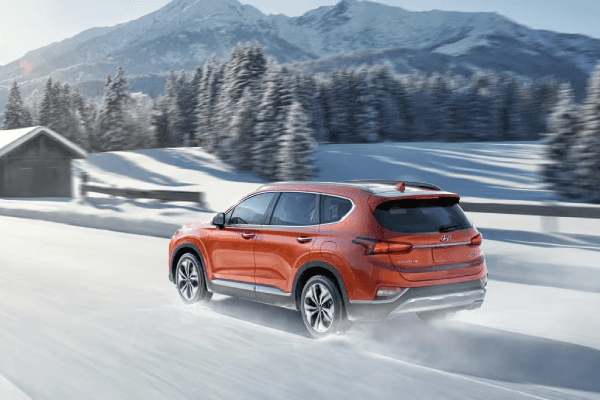
If you’ve decided AWD is worth the extra traction, Hyundai builds it into several models across the lineup. Coverage varies by model and trim, so it’s worth confirming exact availability, but generally you’ll find HTRAC all-wheel drive on:
- Tucson — HTRAC AWD is available across gas and hybrid versions of Hyundai’s compact SUV.
- Santa Fe — Optional on most trims, standard on the rugged XRT trim.
- Palisade — Optional AWD on Hyundai’s three-row family SUV.
- Santa Cruz — HTRAC is available on Hyundai’s sport adventure vehicle.
- Kona — Offered in both front-wheel-drive and all-wheel-drive versions.
Sedans like the Elantra and Sonata remain front-wheel drive only, which is worth knowing if you’re comparing body styles as much as drivetrains. If a spacious SUV with real snow capability is the goal, the Hyundai Palisade and Hyundai Tucson are worth cross-shopping side by side, since both offer HTRAC without stepping into a larger footprint than you need.
Winter Tires and Maintenance Tips for Snow-Ready Driving
Whichever drivetrain you choose, a few maintenance habits make a bigger difference in the snow than most drivers expect.
- Switch to winter tires once temperatures consistently drop into the mid-40s, since all-season rubber stiffens and loses grip in the cold.
- Check tire tread depth and air pressure monthly, since cold air causes tire pressure to drop, reducing contact with the road.
- Keep your battery, wiper blades, and washer fluid topped off, since cold weather is hardest on these components.
- Clear all snow and ice from your windshield, mirrors, and lights before driving, not just a peephole through the glass.
Regular maintenance also keeps your AWD system working the way it’s designed to. Uneven tire wear can throw off how power transfers between axles, so rotating your tires on schedule matters more in winter than in summer. Our team can handle a full winter readiness check, from tire inspection to battery testing, when you schedule a service appointment before the season’s first heavy snow hits Mundelein and the surrounding area.
How to Decide Which Drivetrain Fits Your Winter Commute
The right choice comes down to a few honest questions about how and where you drive. If your daily route includes steep driveways, rural roads, or areas that don’t get plowed quickly, AWD gives you an added layer of confidence getting moving. If you mostly stick to maintained streets around Libertyville and pair your Hyundai with good winter tires, a FWD model can handle the season without issue.
Consider, too, how you use the vehicle beyond winter. AWD typically adds some weight and can modestly affect fuel economy, so if snow season is only a few months of your year, weigh that trade-off against how much extra traction you actually need day to day. There’s no universally right answer, only the setup that matches your routine.
The best way to know for sure is to feel the difference yourself. Schedule a test drive and compare how an AWD SUV and a FWD sedan handle the same turn, the same stop, and the same incline before you decide.
Frequently Asked Questions
Do I need all-wheel drive to drive safely in Chicago winters?
Not necessarily. Many drivers in the Chicago suburbs get through winter safely in a front-wheel-drive Hyundai equipped with a good set of winter tires. AWD becomes more valuable if you regularly deal with unplowed roads, steep driveways, or rural routes where extra traction helps you get moving.
What is Hyundai’s HTRAC all-wheel drive system?
HTRAC is Hyundai’s all-wheel-drive system that continuously monitors driving conditions and shifts torque between the front and rear wheels to maintain traction. It runs in front-wheel drive most of the time to save fuel and automatically sends power rearward when it detects wheel slip or reduced grip.
Are winter tires necessary if my Hyundai has AWD?
Yes, if you want the best possible traction. AWD helps you accelerate and maintain momentum, but winter tires are what actually improve braking and cornering on cold, icy pavement. The most capable winter setup pairs AWD with a dedicated set of winter tires.
Which Hyundai models offer AWD?
HTRAC all-wheel drive is available on the Tucson, Santa Fe, Palisade, Santa Cruz, and Kona, though availability can vary by trim. Hyundai sedans like the Elantra and Sonata are front-wheel drive only.
Which AWD Hyundai models can I test drive at Libertyville Happy Hyundai?
You can test drive AWD-equipped Tucson, Santa Fe, Palisade, Santa Cruz, and Kona models at our Libertyville showroom. Our team can walk you through how HTRAC performs in Snow mode and help you compare it side by side with a front-wheel-drive option.
Whichever you land on, an AWD SUV built for unpredictable roads or a well-equipped FWD Hyundai paired with winter tires, the best Hyundai for snow and ice is the one that matches how you actually drive. Our team at Libertyville Happy Hyundai can walk you through HTRAC, help you compare drivetrains side by side, and get you into the right tires before the next snowfall. Browse our new Hyundai inventory to see current AWD and FWD models, or contact our team with any questions before you decide.
0 comment(s) so far on Best Hyundai for Winter Snow and Ice: Is AWD or FWD Right for Your Winter Drive?